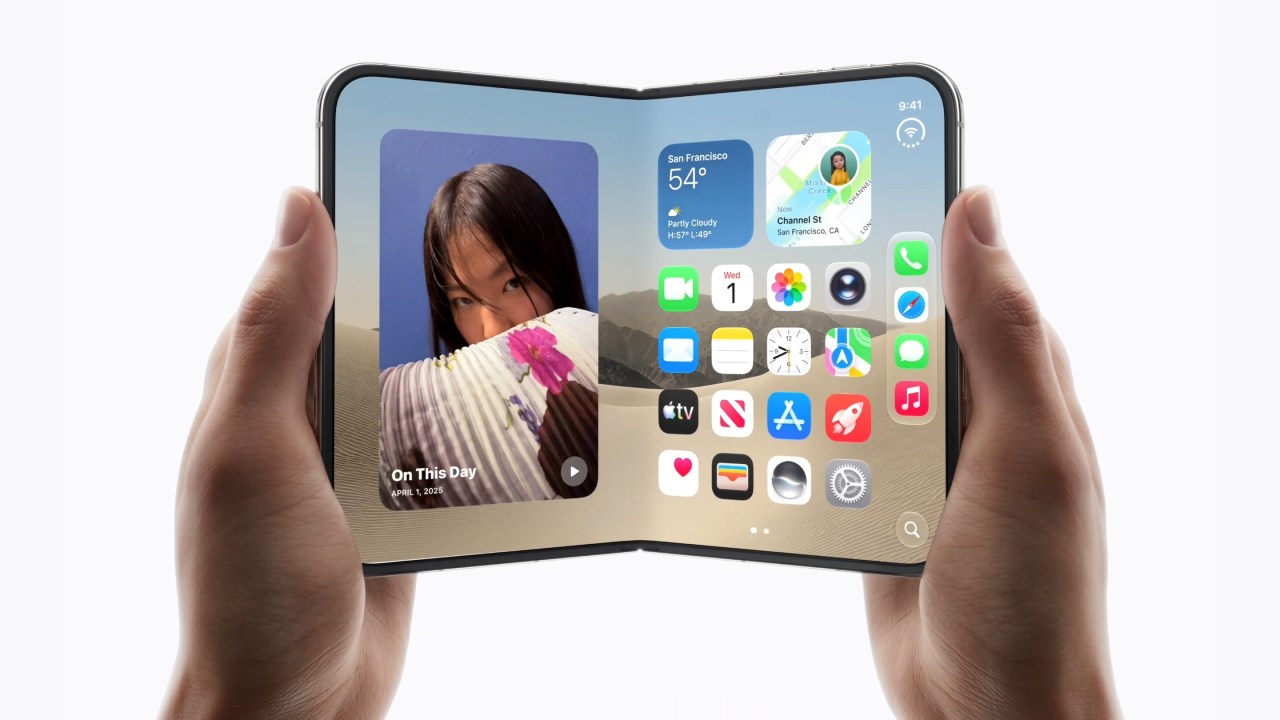
“I think I’ll just go back to using my other iPhone.”
I’ll admit, I said this more than once during the five-day vacation I spent using the new iPhone Duo. Between app glitches, unfamiliar gestures—relearning Touch ID, oh my!—and issues with the camera, I ended up having to carry two phones around with me.
By the time the trip was over, I didn’t even want to go back.
When I first opened the box of the Duo—a tablet-like device loaned to me by Apple—I was genuinely captivated. Tearing off the factory seal and powering on the device, I felt a surge of excitement. Looking back, that may well have been the first sign that the Duo would eventually win me over.
As a tech journalist, I’ve received countless devices for review over the years; sadly, unboxing new gadgets no longer carries the same thrill it once did. Yet, in the days leading up to the Duo’s launch, I found myself genuinely wanting one—I even started crunching the numbers on various upgrade options to see how I might afford the $2,000 device. I also began scrolling through TikTok, checking out reviews of cases for the Duo. I was hesitant—not just because of the price, but because switching to the Duo represented a major shift, especially coming from an iPhone 17 Pro Max. The two devices are worlds apart.
The Duo arrived just as I was heading off on vacation. I decided to bring my 17 Pro Max along, too—just in case. As it turned out, I ended up using the Duo far more, gradually growing accustomed to it throughout the trip, despite encountering a few minor hiccups along the way.
Switching phones always carries a certain psychological cost—especially when moving from a high-end, mainstream device to something as experimental as the Duo. For users accustomed to the polished technology and slim, rectangular form factor of an iPhone, the Duo’s compact, unconventional design can be a bit jarring at first.
“Where did all that screen real estate go?” I wondered aloud. “Can this thing even fit comfortably in a pocket?”
As it turns out, it fits just fine—in either the front or back pocket. Even with a case on, it’s no problem. You can even sit down with it in your back pocket, effectively putting it under pressure, and it won’t break. (I meant to be more careful, but I’d often forget—I’m in the habit of keeping my phone in my back pocket while walking, so I ended up sitting on it countless times. Clearly, it’s not as fragile as it looks.)
I also accidentally dropped the phone at least three times—twice from the height of a table, and once when it was nudged off the edge of a bed. It didn’t land on a soft rug, either; it hit concrete, tile, and hardwood floors. Yet, the phone remained intact, and the screen didn’t crack. I certainly wouldn’t call these professional drop tests, but for someone as prone to dropping their phone as I am, it’s a huge relief.
Of course, I also encountered some frustrating issues. Because the Duo’s outer screen is small, I often had to scroll more to read through previous chat history. Some apps that weren’t optimized—crammed with numerous controls—would occasionally hide key functions inside a “More” (three-dot) menu, making it a chore to find the options I needed. Furthermore, the Google Search app experienced noticeable lag on several occasions.
While this isn’t Apple’s fault, it has become my most frustrating software issue—which is significant, given that search is one of the apps I use most frequently while traveling. On vacation, I’m constantly opening the search app to look up attractions, restaurant reviews, distances between towns, weather, and more. Yet, the Google app frequently stops working altogether, and the “back” button becomes completely unresponsive.
This seems to be a problem specific to the app’s “AI mode”—a mode you’re often forced into without even asking for it. (Which only makes the AI-driven search experience all the more annoying!) For now, the only workaround is to force-close the app; that way, when you reopen it, you’re returned to the standard home screen with the search bar. (It’s truly baffling that Google—which is already struggling with a decline in search volume due to its AI initiatives—hasn’t prioritized ensuring its search app actually functions properly on Apple’s latest devices!)
Furthermore, many early reviews noted that at the time of the Duo’s launch, a large number of apps hadn’t been updated or redesigned. This resulted in noticeable black bars along the sides of the display—further encroaching on an already limited amount of screen real estate when the phone is folded shut. That’s certainly true, but for me personally, it wasn’t the deciding factor that led me to give up on the Duo.
To begin with, major companies are rolling out updates optimized for the Duo quite rapidly. Apps that haven’t been updated yet—and there are still quite a few of them!—remain functional, but their interfaces are, frankly… not very attractive.
During my travels, Google Maps wasn’t optimized for the Duo, yet I encountered no issues using it—whether for driving navigation, local searches, discovery, or route planning. If there’s any real drawback, it’s the black bars around app icons; this is more of an aesthetic issue than a functional one, though the icons do appear smaller than usual when the Duo is folded.
I expect all mainstream apps to be updated eventually. As for those legacy apps that never get updated? I think it’s time to move on from software that is no longer maintained—especially in an era where AI-powered hacking tools are proliferating and outdated software is being ruthlessly exploited.
That said, I agree with other reviewers who have pointed out the lack of facial recognition.
This is the Duo’s biggest shortcoming—it’s not the screen, the camera, or the absence of a dedicated button to launch your preferred AI assistant. It’s the lack of Touch ID.
Glancing at one’s phone is far more convenient than pressing it with a finger. Although I wear an Apple Watch almost all the time—which serves as an alternative form of authentication, making it easy to avoid using Touch ID to unlock my device—I frequently run into issues when using apps or Apple Pay.
When it comes to making payments, the convenience offered by Face ID is clear—it significantly streamlines everyday tasks. Consider the typical scenario: you’re already juggling shopping bags, a wallet, or—in my case—a dog leash, all while trying to hold your phone. Having to switch back to Touch ID at the checkout counter becomes quite a hassle.
Returning to fingerprint authentication requires unlearning certain habits—what I’d call “muscle memory.” I’ve found that the easiest way to hold the phone is to cradle it in my palm and use my thumb for verification. The trouble is, I often forget to keep my thumb or finger on the sensor long enough for the scan to complete. Sometimes, my finger isn’t positioned quite right—blame the dog for tugging on the leash!—and I have to readjust. “I really miss Face ID!” I’ve caught myself complaining more than once at the checkout.
While I’ve managed to get used to using Touch ID again, it’s far from ideal. I can see this becoming a real deal-breaker for some early adopters who might otherwise have picked up the Duo. It’s not an insurmountable issue, but in my view, it’s one of the primary reasons to hold off on buying the Duo right now. (Word has it that future versions will support Face ID.)
Another reason to be cautious about the Duo? Its camera. Much has already been said about the Duo’s lackluster camera system. It only has two rear-facing lenses, compared to the three on my iPhone 17 Pro Max. It lacks a telephoto lens and is limited to 10x digital zoom, whereas the Pro model offers 40x. The Pro version also features more advanced hardware for low-light photography and supports ProRAW, ProRes, and other high-end capabilities.
In short: if you are an iPhone photographer or a content creator, the Duo should not be your primary device.
For the rest of us, however, the Duo’s camera is perfectly fine—not exactly stunning, but sufficient. After all, what do you actually do with your photos? Post them to an Instagram Story or Facebook? Send them to friends? Scroll through them in a home screen widget? Set one as your lock screen wallpaper? None of these require a professional-grade camera.
Below are some photos taken with the Duo, alongside comparisons with shots from the 17 Pro Max. None of the images use special settings or filters; they were intentionally kept simple—much like the results you’d get from a basic, point-and-shoot experience. My main gripe with the Duo is that its image processing can sometimes make details, such as foliage, look over-processed. Meanwhile, distant landscapes can appear a bit flat or overly soft—though, in fairness, the Blue Ridge Mountains are naturally somewhat hazy, so it’s hard to say how much of that is down to the camera itself. (The photo taken from the mountaintop was captured in low light—it was already quite late in the day.)
As for why one would buy this phone? The answer is simple: it’s foldable—and it’s made by Apple. For starters, foldable phones offer a level of fun that traditional slab-style smartphones simply can’t match; they are, quite literally, toys for adults! Developers are clearly enthusiastic about creating apps for this new form factor, so there’s no shortage of fresh experiences to explore. Furthermore, it’s an excellent device for watching movies—especially when paired with a Duo Folio case that features a built-in stand.
Furthermore, this is a foldable device from Apple. The company’s commitment to perfection is evident in numerous details—such as a nearly invisible crease and a consistent aspect ratio across the screens, which ensures that content scales proportionally. Moreover, it functions as a foldable within Apple’s software ecosystem—a crucial advantage for users who frequently switch between various Apple devices and services, or who have invested in apps designed specifically for iOS.
I must confess, however: in my day-to-day life, I haven’t unfolded this “Duo” as often as I had anticipated. (To be clear—I do unfold it, of course! I just expected to do so more frequently!)
There are two reasons for this. First, unfolding the device in public often invites conversation—it can feel a bit like showing off—and I don’t always have the time to chat. I expect this will become less of an issue as the novelty wears off.
Even so, during my vacation, I ended up striking up conversations with about half a dozen strangers—ranging from fellow customers and restaurant staff to business owners. I even handed the phone to a few of them (only when it was safe to do so, of course!) to let them experience the folding and unfolding action. One person was particularly interested in the “Kids Prompt” feature, which displays playful Snoopy animations on the outer screen to help direct children’s gaze toward the camera lens when taking a photo. They were quite fascinated by it.
Many people expressed amazement upon seeing the unfolded screen, with comments like, “You can’t see the hinge at all!” and “Is that a screen protector, or is it just built that way?” (The inner display features a matte, nano-textured surface designed to reduce glare—a detail that drew praise as “really cool” once explained.)
“What happens if sand gets inside?” asked a former Samsung Galaxy Fold user. Their previous Android foldable was ruined after a trip to the beach—sand found its way into the hinge and damaged the screen. (Such incidents were not uncommon back then.) The Duo carries an IP68 dust-resistance rating; the “6” indicates a high level of protection, making it completely dust-tight. By comparison, the Galaxy Z Fold 8 has an IP48 rating. While I don’t expect the Duo to suffer the same fate, I’m certainly hoping some reviewer takes it to the beach soon to put it to the test!
I’m certain that at least one of the few strangers I’ve spoken to had never seen a foldable phone before. With Apple now entering the foldable market, this concept is set to move beyond a niche curiosity and become widely recognized by the general public.
Another reason I don’t unfold my phone as often as I might have expected is that doing so feels like the start of a more intentional screen-time session. When I unfold it now, it’s because I’m genuinely focused on a specific task—like watching a show on Netflix or multitasking with two apps side-by-side in split-screen mode. (Personally, I like to read the news on Inoreader while keeping the X app open alongside it to see what people are saying—though that particular workflow might not be for everyone!)
The split-screen feature is also very easy to use: once you’ve opened an app, swipe up from the bottom and then drag it toward the left or right edge. Target zones appear on either side, providing a helpful visual guide for where you can place the app. (You can also long-press an app icon to trigger split-screen view, though I don’t use that method very often.)
In terms of screen size, this phone is essentially a “mini” device when folded shut; consequently, it holds far less appeal for apps I consider time-wasters—like TikTok, Instagram, or casual games.
I’ve been reflecting on this, and I don’t think it’s simply a matter of limited screen real estate when folded, or the fact that apps designed for vertical screens aren’t optimized for the horizontal layout of the unfolded Duo. While those concerns are certainly valid from a standpoint of utility and usability, I believe there is a deeper reason for this shift in behavior.
For years, smartphones have grown larger, taller, and thinner, becoming increasingly comfortable to hold—which, in turn, makes it all too easy to get lost in the digital world. The design of the Duo, however, seems to disrupt the way smartphones typically draw us in, coaxing us to open apps and scroll endlessly without a second thought.
Instead, the Duo feels like a device you open only when you actually need to use it—rather than something you reflexively reach for whenever you’re bored or have a few spare minutes. Because the optimal way to use apps is with the device unfolded—an action that requires deliberate intent (and a bit of careful handling!)—engaging with the device becomes a much more conscious, thoughtful process.
This is not a bad thing. It also aligns with the emerging “retro-tech” trend, where the presence of knobs, dials, and physical buttons makes our interactions with technology feel more intentional.